Marvel gave me the brief. I built the companion.
Kairo is a self-initiated project, not client work. Marvel's Vision made me wonder why the AI I use never knows me. Kairo is a personal AI and voice assistant that builds its understanding of you from the data you give it, keeps only what you approve, and answers in short, calm sentences, aloud or on screen.
AI assistants start from zero and treat everyone the same.
A companion that learns only what you approve, and talks like Vision.
A working Mac app with memory, voice and a 3D character.
I wanted the AI from the films, not another chat box.
The assistants I could buy knew nothing about me.
Watching Marvel, the AI that stayed with me was never the powerful one. It was J.A.R.V.I.S. and then Vision: something that already knew who Tony was, spoke in a few calm words, and was the same entity on a good day and a bad one.
Every assistant I could actually use started from zero. I had to explain who I was in every session, and it answered like it was talking to anyone. Kairo is my attempt at the other version: a personal AI and voice assistant that learns from the data I give it, then talks to me as someone it knows.
Not a smarter assistant. One that already knows you.
Kairo does not retrain a model. It learns the way a good colleague does: by keeping organised notes about you that you approve, and reading them before it answers.
It learns only from what you hand it.
There is no hidden scraping and no silent memory. Kairo has three ways in, and each one is something you did on purpose.
Your profile
Background, goals and how you like to be answered. One profile per context, such as an interview, a sales role or a 1:1. Nothing is shared between profiles.
Your links
Paste a page or a whole site and Kairo reads it in a sandboxed browser, then files what matters into your memory.
Your conversations
While you talk, it proposes things worth keeping. Small talk and one-off logistics are dropped. Everything else waits for you.
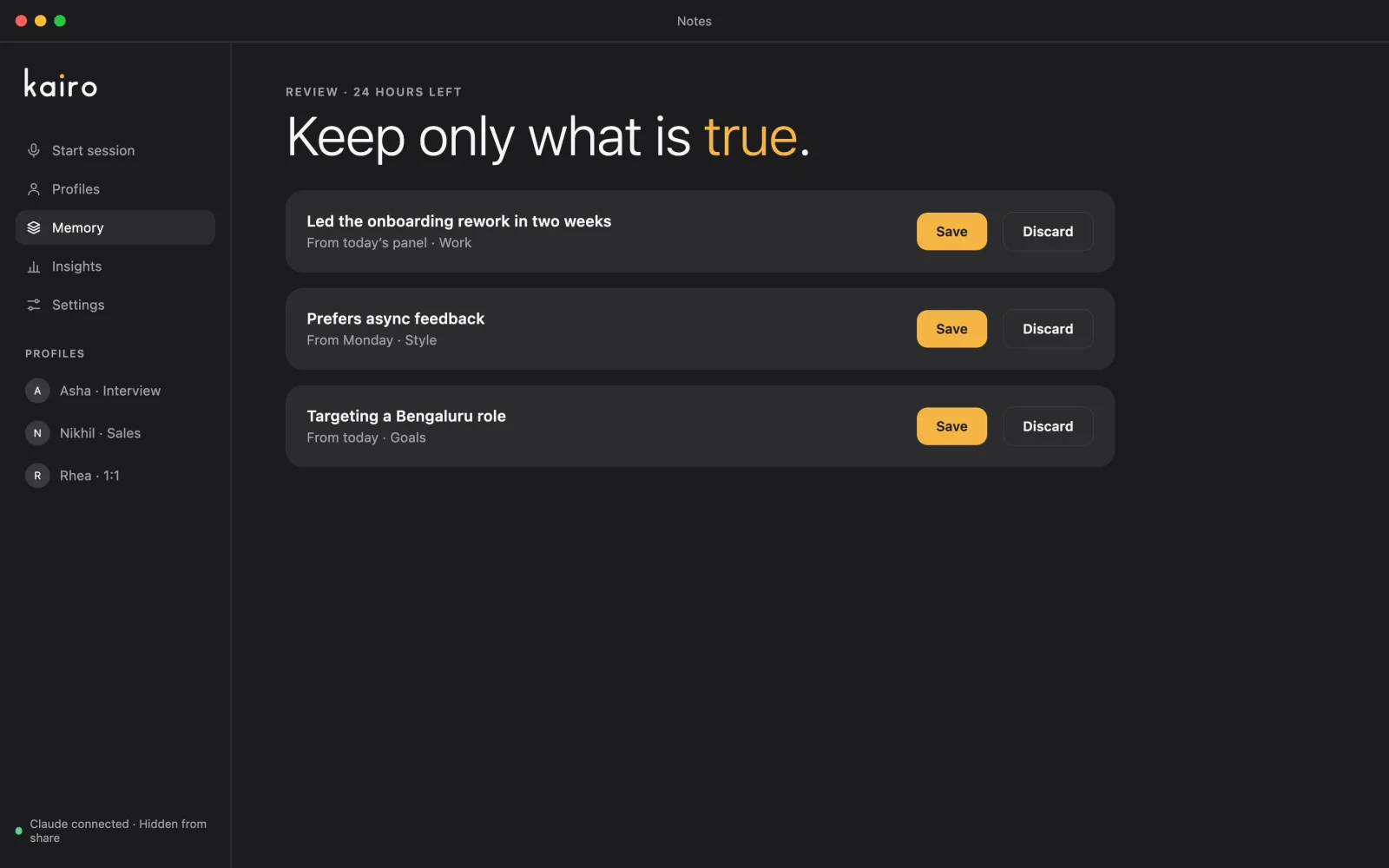
The review screen says "Keep only what is true." A personal AI is only useful if you trust what it believes about you, so saving is always your call, never the model's.
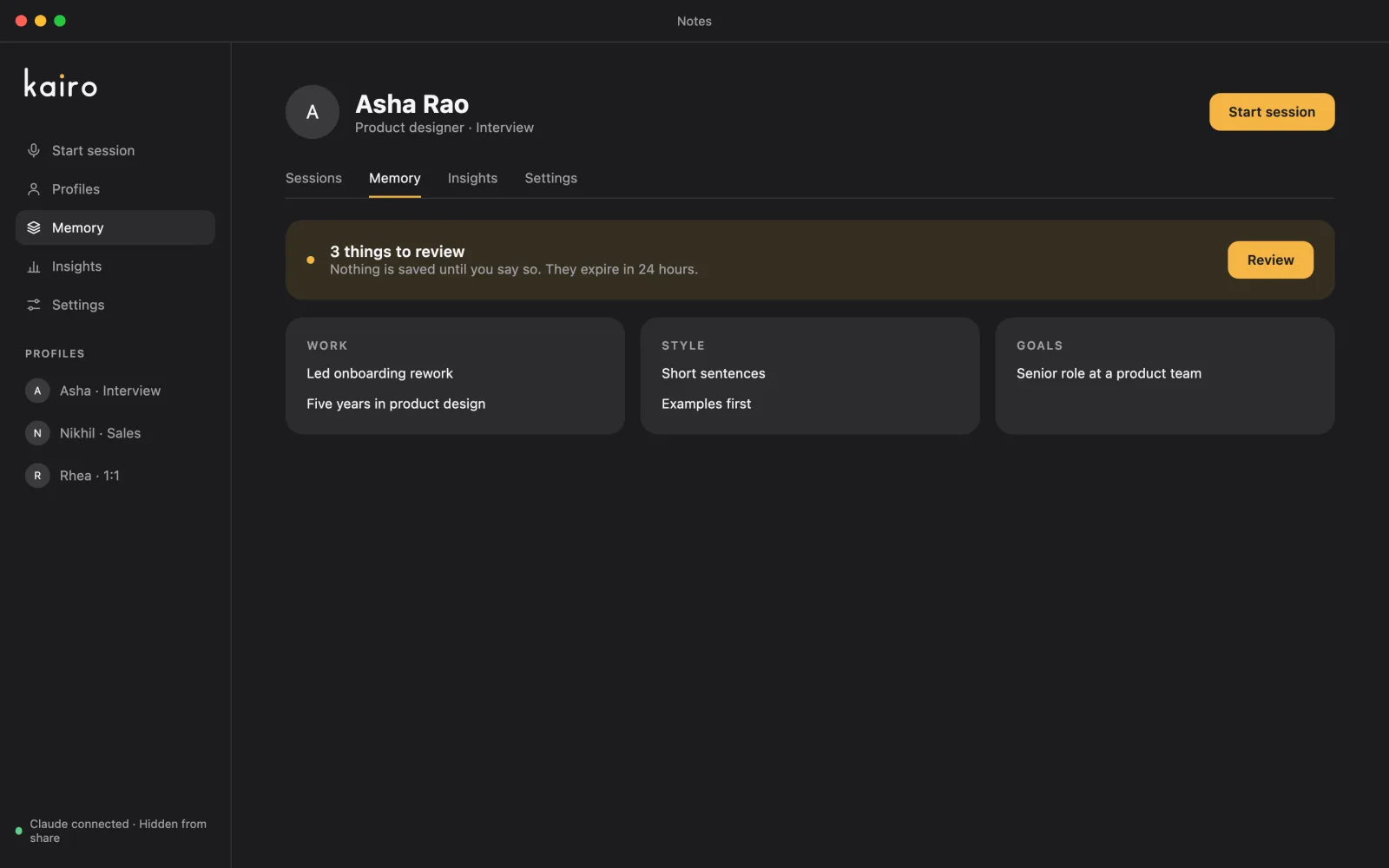
A companion with two registers, taken from Vision.
Vision is the Mind Stone's intelligence, J.A.R.V.I.S.'s calm and a creator's craft. I split that into two ways of talking, and Kairo chooses one for each moment.
Heart
For stress, grief, doubt and hard days. It names what it hears in one true sentence, does not rush to fix, and asks what it is like for you.
Mind
For problems, decisions and ideas. It leads with the crux, gives its pick and the one-line trade-off, and stops. A peer who makes you sharper.
Short on purpose
He is heard, not read. Replies cap at three sentences and 30 words, so the voice never lectures.
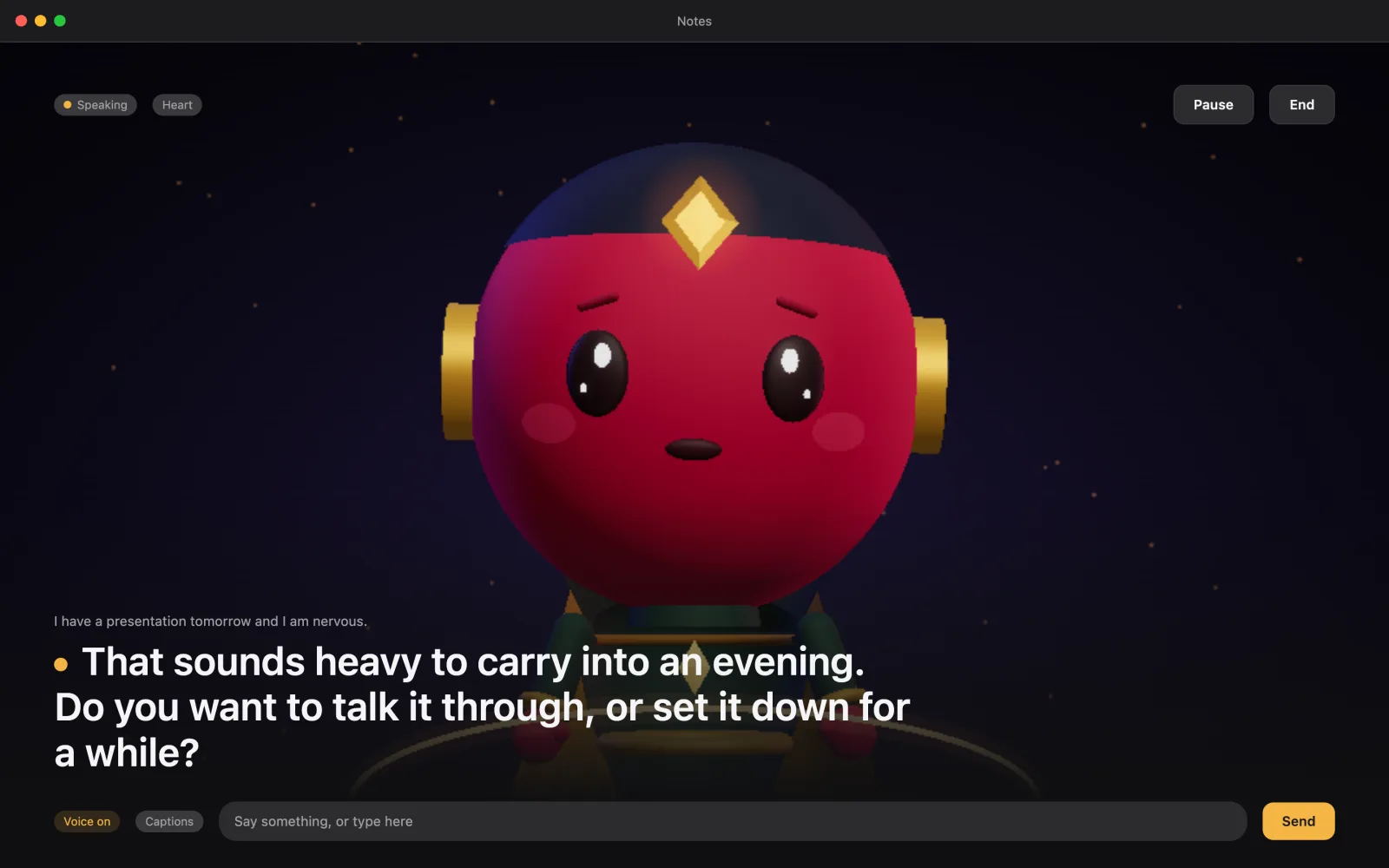
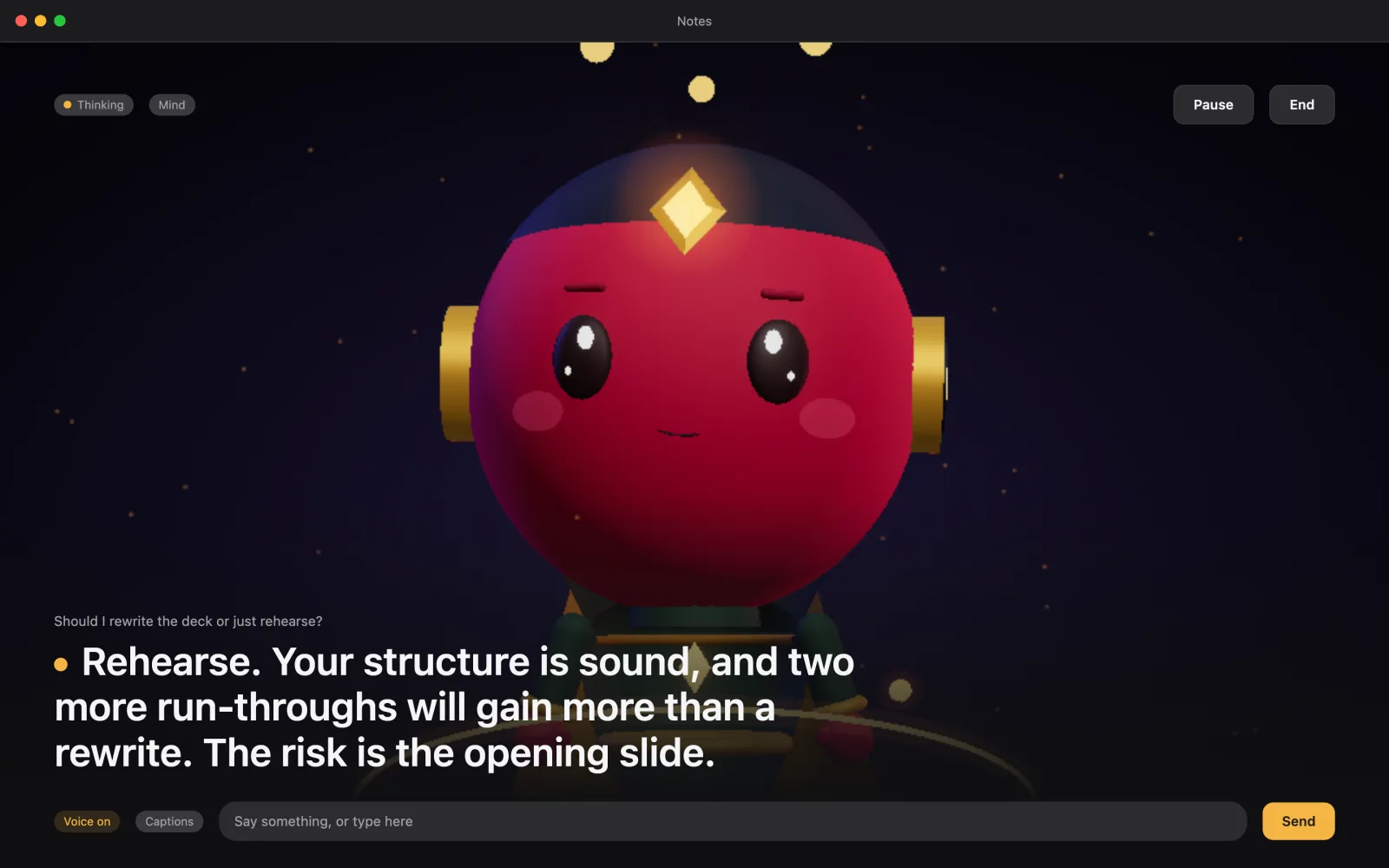
I made the 3D face matte and low-glow on purpose. The glossy, glowing version looked like a sci-fi prop. A companion you talk to every day should feel calm, so the only light on screen is the gold gem on his forehead.
Voice first, with captions for when you cannot listen.
You can talk to Kairo or type. It answers aloud using a macOS voice, tuned toward a lower, calmer pitch and slower pace. If you talk over it, it stops and listens, the way a person would.
The picker is built for eight companions. Only Vision exists today. The other seven are marked Coming soon rather than faked.
I tuned the voice by measuring pitch, not by ear against the actor, and it is the closest an offline system voice gets. I have not yet validated barge-in with a real human voice through the installed app.
A personal AI has to be quiet about what it knows.
Private
Speech is transcribed on the Mac. Answers come through your own Claude account. Nothing leaves except the text sent for the answer.
Hidden
The window is excluded from screen sharing and recordings, and carries a neutral title.
Plain
Calm, short, specific copy. No sparkles, no hype words, no exclamation marks in the product.
A working Mac app, not a launched product.
Kairo runs as a macOS app with profiles, memory, four session purposes (ideate with AI, offline meeting, online meeting, and 1:1 with Vision) and the Vision companion. It has a unit-test suite and an end-to-end smoke test. It is not publicly released.
Next: test the voice loop with real people, build the second companion, and settle the name before any public launch.